
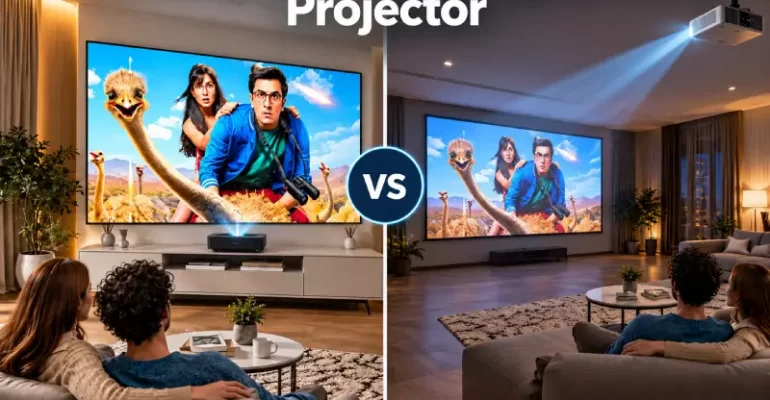
Short Throw vs Long Throw Projectors: Which Is Right for Your Room?
 hotack
Compare short throw vs long throw projectors, understand throw ratios and screen distances, and choose the right projector for your home theater or office.
The right projector throw distance depends on your room layout, screen size, and installation options. A short throw projector can create a large image in a compact space, while a longer throw projector may suit rooms with more depth.
However, neither option is automatically better. Understanding throw ratio helps you select a projector that fits your space without unnecessary installation adjustments.
What Is Projector Throw Ratio?
Throw ratio describes the relationship between the distance from a projector’s lens to the screen and the width of the projected image.
Throw Ratio = Projection Distance ÷ Image Width
For example, a projector with a 1.0:1 throw ratio needs approximately 2.21 meters between the lens and screen to produce a 100-inch diagonal image in a 16:9 aspect ratio.
A projector with a 0.5:1 throw ratio needs approximately 1.11 meters for the same image width. A lower throw ratio generally means the projector can be placed closer to the screen.
Actual installation distances may vary with the lens position, optical design, and manufacturer’s specifications.
Short Throw vs Long Throw Projectors: Quick Comparison
Projectors are often described as ultra-short throw, short throw, standard throw, or long throw. These categories are approximate, and manufacturers may use different boundaries.
| Throw Type | Typical Throw Ratio | Approximate Distance for a 100-Inch Image | Common Applications |
|---|---|---|---|
| Ultra Short Throw (UST) | Below approximately 0.4:1 | Less than 0.9 m | Compact home theaters and TV replacement setups |
| Short Throw | Approximately 0.4–0.8:1 | About 0.9–1.8 m | Small rooms, gaming, and meeting spaces |
| Standard Throw | Often around 1.0–1.5:1 | About 2.2–3.3 m | Living rooms, offices, and classrooms |
| Longer Throw | Often above 1.5:1, depending on the lens | About 3.3 m or more | Dedicated theaters, lecture halls, and larger rooms |
Distance estimates assume a 100-inch diagonal, 16:9 image with a width of approximately 2.21 meters. Use the exact throw ratio and installation specifications of your selected model when planning a setup.
What Is a Short Throw Projector?
A short throw projector uses optics designed to produce a large image from a relatively short distance. This makes it useful when a room cannot accommodate a projector several meters away from the screen.
Depending on the model, a short throw projector may sit on a table, a shelf, or a suitable mounting bracket near the projection surface.
Advantages of Short Throw Projectors
- Space-saving installation: Create a large image without placing the projector at the back of the room.
- Reduced beam obstruction: A projector positioned near the screen can reduce the likelihood of people walking through the projection beam.
- Flexible room layouts: Short throw models can work well in apartments, bedrooms, small meeting rooms, and compact entertainment spaces.
- Convenient placement: Depending on the design, the projector can be positioned on furniture rather than mounted at the back of the room.
- Large images in smaller spaces: A suitable throw ratio allows users to achieve their target screen size with less projection distance.
Potential Limitations of Short Throw Projectors
- Placement sensitivity: Small changes in position can noticeably affect image alignment and geometry.
- Optical design requirements: Specialized lenses may increase manufacturing complexity and product cost.
- Limited zoom flexibility: Some models offer little optical zoom, making precise placement more important.
- Surface requirements: The projection surface should be flat and suitable for the selected throw ratio, particularly with ultra-short throw designs.
Short throw does not automatically mean higher brightness or better image quality. Compare measured brightness, resolution, contrast, lens performance, and the intended screen size when evaluating individual models.
What Is a Long Throw Projector?
A long throw projector is designed to produce an image from a greater distance. It can be suitable for rooms with sufficient depth, including dedicated home theaters, conference rooms, lecture halls, and larger presentation spaces.
Depending on its lens and installation requirements, a long throw projector may be mounted on the ceiling or positioned farther from the screen to keep equipment away from the main viewing area.
Advantages of Long Throw Projectors
- Suitable for deeper rooms: The projector can be placed farther from the screen when the available space supports it.
- Flexible installation options: Selected models support ceiling mounting, optical zoom, or lens shift.
- Less equipment near viewers: A rear-mounted projector can keep the main viewing area clear.
- Options for larger venues: Long throw configurations are available for classrooms, auditoriums, and professional installations.
- Broad product selection: Buyers can compare different lens ranges, brightness levels, resolutions, and installation features.
Potential Limitations of Long Throw Projectors
- Greater space requirements: The room must provide enough distance to achieve the desired image size.
- Beam obstruction: People or objects between the projector and screen can block the image.
- Installation planning: Ceiling mounting may require suitable brackets, cable routing, and alignment.
- Limited suitability for compact rooms: A long throw lens may not produce the required image size when the available distance is insufficient.
A long throw projector is not inherently sharper or brighter than a short throw projector. Image quality depends on the complete optical system, light output, resolution, and operating conditions.
Ultra Short Throw vs Short Throw Projectors
Ultra-short throw (UST) is a distinct category within close-range projection. A UST projector can produce a large image from a distance of only a few dozen centimeters.
For example, a projector with a 0.19:1 throw ratio requires approximately 0.42 meters of lens-to-screen distance for a 100-inch, 16:9 image.
By comparison, a short throw projector with a 0.8:1 ratio needs approximately 1.77 meters for the same image width.
| Feature | Ultra Short Throw | Short Throw |
|---|---|---|
| Placement | Very close to the screen | Closer than standard throw, but usually farther away than UST |
| Room Requirements | Useful where projection depth is extremely limited | Suitable for compact and medium-sized rooms |
| Surface Sensitivity | Often highly sensitive to surface unevenness and alignment | Depends on lens design and projection geometry |
| Installation | Precise distance and alignment are especially important | Positioning still needs to follow the specified throw ratio |
UST projectors can be convenient for TV replacement, but they generally require a particularly flat projection surface. Small surface irregularities can become more visible because of the steep projection angle.
For the best results, check the manufacturer’s recommended screen type, projection distance, and alignment requirements.
Which Projector Throw Type Is Best for Your Room?
The right choice depends on your room depth, target screen size, projector placement, and viewing conditions.
Choose a Short Throw Projector If…
- Your room has limited depth.
- You want a large image without placing the projector at the back of the room.
- You need to reduce the chance of people obstructing the projection beam.
- You prefer a compact setup for a bedroom, small living room, or meeting space.
- Your chosen model provides the required throw ratio and screen size.
Choose a Long Throw Projector If…
- You have sufficient room depth for the desired image size.
- You want to position the projector farther from the main viewing area.
- You are installing a projector in a dedicated home theater, classroom, or large meeting room.
- Your installation benefits from the lens options available on a longer throw model.
- You can accommodate the required mounting position and cable routing.
Consider an Ultra Short Throw Projector If…
- You want a large image with the projector positioned very close to the wall or screen.
- You are replacing a television in a compact living space.
- You can provide a flat, suitable projection surface.
- You can follow the manufacturer’s precise placement and alignment requirements.
Four Things to Check Before Choosing a Projector
1. Measure Your Available Projection Distance
Measure the available distance between the intended lens position and the screen. Then calculate the throw ratio needed for your target image width.
For example, if the image width is 2.21 meters and the available projection distance is 1.1 meters, the required throw ratio is approximately 0.5:1.
Always check the actual lens position and installation measurements specified by the manufacturer.
2. Decide on Your Screen Size
A 100-inch, 16:9 screen has an image width of approximately 2.21 meters. Larger screen sizes require a greater image width and therefore a different projection distance for the same throw ratio.
Choose the target screen size before selecting a projector. This helps avoid buying a model that cannot achieve the desired image size within your room.
3. Consider Ambient Light and Brightness
Brightness is especially important when viewing in rooms with ambient light.
Compare ANSI or ISO lumens where available, and consider the intended screen size, image content, and lighting conditions.
A suitable throw ratio helps with placement, but it does not replace the need for adequate light output.
4. Check Mounting, Focus, and Image Correction
Confirm whether the projector will sit on furniture, use a ceiling mount, or require another installation method.
Also review focus adjustment, keystone correction, lens shift, and optical zoom where applicable. These features affect installation flexibility, but digital image correction should not be treated as a substitute for correct physical placement.
For more help comparing projector specifications, read our projector specifications glossary.
Hotack Projectors for Different Throw Distances
Hotack offers projector platforms for different room layouts and viewing requirements. The correct model depends on its throw ratio, native resolution, brightness, and intended application.
Hotack D068: Ultra Short Throw Projection
The Hotack D068 is an ultra-short-throw projector with a 0.19:1 throw ratio, native 1920 × 1080 resolution, and 650 ANSI lumens.
Its close-range projection design allows a large image to be produced from a short distance, making it worth evaluating for compact home entertainment setups and other suitable applications.
For a 100-inch, 16:9 image, a 0.19:1 throw ratio corresponds to approximately 0.42 meters of lens-to-screen distance. The actual installation should follow the model’s specified distance and alignment requirements.
Buyers should also evaluate brightness against their room lighting and screen requirements before choosing the D068.
Hotack X3AA: Short Throw Portable Projection
The Hotack X3AA is a portable Full HD projector with a 0.8:1 throw ratio and 200 ANSI lumens.
Its short throw design supports flexible placement in smaller viewing spaces, while its compact form and adjustable stand provide additional positioning options.
With 200 ANSI lumens, the X3AA is better suited to dim or dark viewing environments than brightly lit rooms.
View the Hotack X3AA Full HD portable projector.
Explore the full Hotack projector range to compare additional models and configurations.
Projector Throw Ratio and OEM/ODM Product Development
For projector brands, distributors, and importers, throw ratio is an important specification when selecting products for different customer groups.
A compact apartment projector, a classroom projector, and a dedicated home theater projector may require different optical configurations.
When evaluating an OEM or ODM project, consider the following requirements:
- Target application: Home entertainment, gaming, education, business, or specialized installation.
- Throw ratio: The required lens-to-screen distance for the intended image size.
- Native resolution: The actual display resolution required by the target market.
- Brightness: The required light output for the expected viewing conditions.
- Product design: Dimensions, mounting options, cooling, and optical requirements.
- Commercial requirements: Target cost, expected order quantity, packaging, and customization scope.
Hotack provides projector OEM and ODM manufacturing services for brands and business buyers. Available product configurations and customization options depend on technical feasibility and project requirements.
Learn more about our projector OEM and ODM solutions for product development and manufacturing.
Frequently Asked Questions About Short Throw and Long Throw Projectors
What is the difference between short throw and long throw projectors?
Short throw projectors use a lower throw ratio to produce a large image from a shorter distance. Long throw projectors are designed to project from farther away and can suit rooms with more depth.
Is a short throw projector better for a small room?
Often, yes. A short throw projector can produce a large image with less projection distance. However, you should calculate the required throw ratio and confirm the available installation space before choosing a model.
What throw ratio do I need for a 100-inch screen?
For a 100-inch, 16:9 image, the width is approximately 2.21 meters. Multiply this width by the projector’s throw ratio to estimate the required lens-to-screen distance.
Are ultra-short-throw and short-throw projectors the same?
No. Ultra-short-throw projectors have particularly low throw ratios and can produce large images from very close to the screen. Short-throw projectors generally require more distance than UST models.
Does a short throw projector produce a brighter image?
Not automatically. Brightness depends on the projector’s light output and optical system, along with the image size and viewing conditions. Compare measured brightness specifications rather than relying on throw ratio alone.
Can I use a long throw projector in a small room?
It depends on the projector’s minimum throw distance and the desired image size. If the room cannot provide enough distance, a short throw or ultra-short-throw model may be more suitable.
Choose the Right Projector for Your Space
The best projector is the one that matches your room dimensions, screen size, brightness requirements, and installation preferences.
Short throw projectors can help maximize image size in compact spaces, while long throw models are suitable for installations with greater projection distance. Ultra-short-throw projectors offer another option when the available space is especially limited.
Before purchasing, compare the actual throw ratio, native resolution, brightness, and installation requirements of each model.
Hotack provides projector products and OEM/ODM manufacturing solutions for brands, distributors, and other B2B customers.
Contact Hotack to discuss projector specifications, product selection, and OEM/ODM requirements.
